
TIMELINE
4 Weeks.
October 2025
TEAM
3 Student
Designers
CONTRIBUTION
Research, Ideation, Prototyping, Testing
WHERE DID I USE AI?
Prototyping the final concept
TL;DR
RX/Ai is an AI plugin for hospital pharmacists that flags potential drug-drug interaction before the medication reaches the patient. It works on top of the existing software hospital pharmacists already use for a minimal learning curve. The main features include flagging risks, suggesting alternatives using AI, and notifying doctors.
The product is built on the human-in-the-loop method, ensuring pharmacists stay in control of the final decision. The purpose of the AI is to ensure they never miss anything in this high-stake environment.


WHAT DID I DO
Led research and synthesis across secondary literature, 2 in-depth pharmacist interviews, and competitor analysis, narrowing three problems down to medication-error prevention
Mapped pharmacists' end-to-end mental models and decision-making workflow, then scoped the AI intervention to cross-checking, the one high-friction, low-judgment task in their day
Owned wireframes, prototyping, and UI/UX from concept through a practicing pharmacist's expert evaluation, translating feedback into two key changes
TOOLS USED


THE PROBLEM
Medication errors are costing lives
6.5/ 100
Patients are administered incorrect medication
30-70%
of the errors are identified bynNurses and pharmacists
1.5M
People are affected every year due to medication errors
21.6%
Prescribing errors with wrong drug or wrong dose
WHY PHARMACISTS
Pharmacists are the last checkpoint before a prescription reaches the patient
Doctors prescribe, and they're already overloaded, so adding another system raises their burden without giving them anything back. Nurses catch errors too, but they're constantly mobile and rarely at a screen long enough for a digital tool to matter.
Pharmacists are different: they sit at the junction between doctor and patient, they have the authority to flag or modify a prescription, and critically, they already work inside structured digital workflows. That combination, authority plus an existing digital habit, made them the only role where an AI intervention had somewhere to live.
"When I know a patient has a cocktail of medications, I usually manually open up their past prescriptions and cross-check it with the new prescription. It's not easy to always pick up on possible issues."
Clinical Pharmacist, Primary Interview
DESIGN APPROACH
Designing within constraints: Research, Compliance, and Choosing the right AI
Understanding the Pharmacists: We paired secondary research with primary interviews and mapped how pharmacists actually think through a shift, not just what tools they use. We spoke with 2 clinical pharmacists to understand their pain points and mapped their day-to-day mental model.
HIPAA Compliance: AI in healthcare sits in a gray area: models need data to learn, but patient data is highly protected. Keeping data on-site and de-identifying it helps make AI adoption more feasible. Under HIPAA’s Safe Harbor method, removing all 18 specified patient identifiers means the data is no longer considered Protected Health Information (PHI).
Defining the AI Approach: Drug interactions and contraindications are structured, rule-based problems, making ML a better fit than open-ended AI approaches. It offers more predictable outputs, clearer traceability to data points, and easier validation against established medical sources.
INSIGHTS
Inventory reconciliation and dispensed-drug verification were the biggest sources of friction, especially when a second pharmacist wasn't around to double-check during peak hours
The interactions pharmacists miss aren't the obvious ones. A drug that's dangerous on its own gets caught. The risk is the borderline case: a drug that's fine alone but wrong for a specific patient's full history, the kind of thing that gets missed under time pressure, not through negligence
Cross-checking eats time but takes comparatively little judgment, which is what made it the right place for AI to sit. We didn't want to touch the parts of the job pharmacists actually value
EXPERT EVALUATION & ITERATION
What a practicing pharmacist taught us
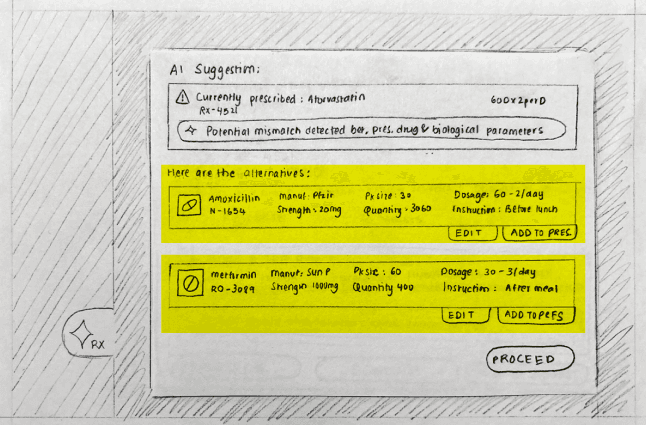
Reasoning behind the AI suggestion: "Why A and not B? I would know but it helps". Having reasons for every AI suggestion to build trust and improve experience

We rewrote how the AI talks about risk: A system that can be wrong, shouldn't sound certain. We shifted the tone of our copy from definitive to suggestive
WHAT WE SHIPPED
Intervenes only when needed
The plugin runs quietly in the background while a pharmacist scans a prescription. If it catches an abnormality, it surfaces a notification. If it doesn't catch one automatically, pharmacists can open the plug-in manually.
AI Flags, Pharmacists Decide

The AI scans prescriptions for potential risks, drug allergy conflicts, drug-drug interactions, contraindications, and diagnosis mismatches. Although the AI detects the risk, the final decisions are left to the pharmacist based on certain choices made.
Severity over a binary flag: A yes/no flag would treat a minor interaction the same as a life-threatening one, which just adds noise pharmacists learn to ignore. Severity lets them judge for themselves how urgent it is to act.
Every description is sourced: Pharmacists cross-verify with each other constantly, so providing claims without supporting evidence would introduce another layer of uncertainty rather than reduce their workload.
Notifying the Doctor
The pharmacist can choose to opt for physician approval by adding a note and send the request directly to the doctor through RX/Ai. Instead of relying on a phone call and waiting for the doctor to become available, the request is documented and routed directly for review, reducing interruptions for both clinicians.
Suggesting an Alternative
If a medication poses a potential risk, the pharmacist can suggest an alternative medication as part of the approval request. The doctor can then review the recommendation and respond directly with an approval or an alternate medication, closing the communication loop without requiring a back-and-forth phone call.
Closing the Communication Loop

The pharmacist can see the doctor-approved change directly within the prescription, with the original and replacement medication clearly shown side by side. This closes the communication loop.
The Controlled Substance Boundary

For controlled substances, AI cannot suggest alternatives. Pharmacists can only notify the doctor, reflecting both regulatory requirements and pharmacists’ need for direct physician oversight in higher-risk decisions.
IN HINDSIGHT
The gaps I'd fix next
01
No audit trail: The plugin doesn't log what data it saw or why it flagged something. For FDA validation or HIPAA accountability, every output needs to be reconstructable: why did the system say this, based on what. Scoped out for time, but it'd be first in the next iteration.
02
No way to correct the system: Pharmacists can override a flag but can't tell the AI it was wrong for a specific patient. Without that feedback loop, the same near-miss can repeat.
WHAT I GOT OUT OF THE PROJECT
Word choices matter more in high-stakes environments
The biggest shift in how I think about AI design: a single word choice moved trust more than the information architecture did. I assumed the hard part would be getting the right data in front of the right person at the right time. What nearly broke the tool was language that claimed more certainty than the system actually had.
Next time, I'd bring a practicing pharmacist in during ideation, not after a working prototype. We only caught the override screen and the copy problem because we happened to test with someone who does this job daily. Those should've been stress-tested from day one.

You reached the end! Have an AI-generated cookie.
AI still can't replicate the taste. Want a real cookie? Let's chat. (Click the cookie to eat it.)